


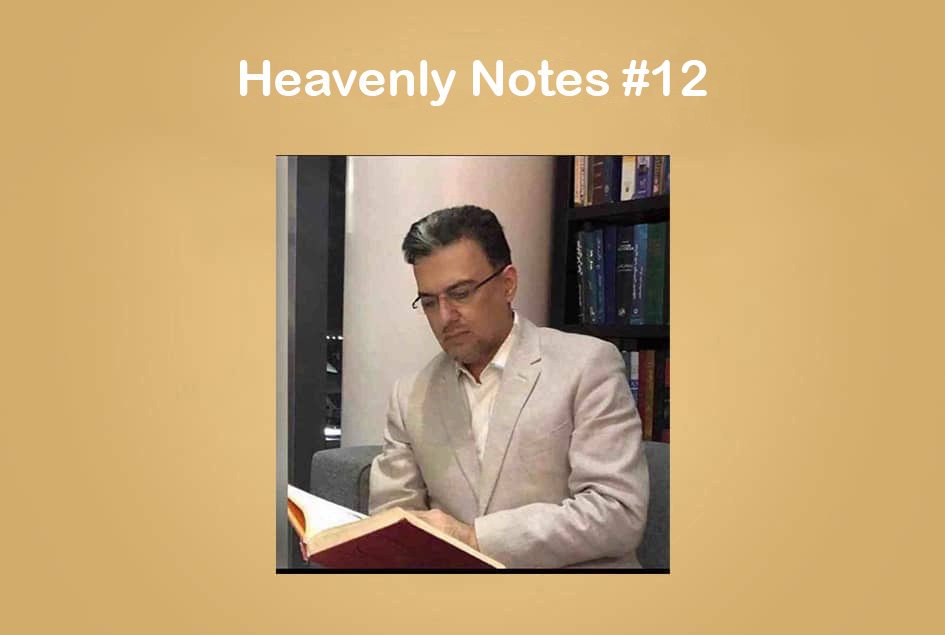
Continuation of Lecture Three: Seyyed Mohammad Taqi Hashemian
Traditionalism in Iranian Culture and Art
Throughout Iran’s history, magnificent masterpieces of artistic works have emerged—masterpieces that exemplify ancient Iranian art and reflect the spiritual presence inherent in these creations. What is now required is to recover the true principles and foundations of sacred and traditional art. From the standpoint of traditionalists, religious art refers only to art that has a direct relationship with religious rituals and culture—that is, art that is fundamentally inspired by religion and religious rites. In the view of traditionalists, religious art and traditional art are two aspects of a single spiritual art; however, more important than these two is the form of art they call sacred. Among these three aspects of spiritual art, clear distinctions exist.
Sacred art has its own unique language, and its message is universal. The message of sacred art is the same across all religions, but the manifestations of this message take on forms specific to each religious tradition. Within Christianity, this aspect appears in iconography; within Islam, it is manifested in the art of Qur’anic recitation, calligraphy, sacred architecture, and even in certain literary and mystical works.
The truth is that the term “tradition”—as it has been used in Persian in recent decades within religious, philosophical, and sociological contexts—like many borrowed words, merely appears Arabic while having lost its original meaning through its connection with Iranian culture. This word in Arabic has multiple meanings, the most well-known of which are: method, custom, practice, habit, and instruction. In religious contexts, it is used with similar meanings, specifically to indicate the sayings and actions of the infallible figures. Many such terms in Persian have acquired meanings completely different from their original sense. Even some Qur’anic terms and combinations—“sunna” being one of them—despite their context of revelation and the fact that they should not undergo alteration, have acquired meanings that are the very opposite of their original intent. Among these is the well-known phrase “kun fayakūn,” which originally means “to become,” “to come into existence,” or “to be created,” but in Persian is understood to mean “to vanish” or “to completely disrupt something from its foundations” (Dehkhoda).
The word “tradition” as it is used in modern Persian discourse has none of the meanings attributed to it in Arabic. Scholars of religion, in discussing tradition and traditionalism, focus on concepts opposed to fundamentalism—meaning that form of religiosity and religious thought that remains faithful to original teachings while embracing religious tolerance, and unlike fundamentalism, prefers moral exhortation over direct involvement in political and worldly authority.
Philosophers and sociologists, on the other hand, understand tradition as something opposed to modernization—or, more broadly, to modernity. In other words, from the viewpoint of most philosophers, and especially sociologists, tradition refers to a culture, mindset, and set of customs that have ceased to evolve and have become obstacles in the path of modernity.
If we examine the matter more closely, tradition within Iranian society has a meaning entirely different from what religious scholars, philosophers, and sociologists propose. It is a meaning that must be extracted from within the fabric of Iranian cultural history. Yet traditionalism also has another perspective: Iranian traditionalism. This form of traditionalism does not align with the definition posited by religious thinkers, because despite its rootedness in origins, it moves along with the collective culture and intellect of society—in other words, with history. It is capable of transformation and, although founded upon ancient thought, it bears a contemporary form. This is the tradition that, in the words of Henry Corbin, is “the beating heart of Iranian culture.” A tradition that became manifest in Illuminationist philosophy, revealed itself in Iranian mysticism, and nurtured Shi‘ism within its bosom. This tradition is neither confined to primordial myths nor in conflict with modernity, for it is a worldview formed at the dawn of the Iranian peoples and, over thousands of years, has journeyed through history—absorbing or rejecting subcultures, being affirmed by successive generations, and ultimately reaching the present era.
Thus, innovation and modernism are now part of this tradition. Iranian tradition, as history attests, has always absorbed any cultural obstacle it encountered along its path and—without losing its identity—re-emerged in a new form built upon ancient foundations. One might suppose that this definition could also apply to culture itself, but it must be noted that culture arises within the context of tradition—built upon temporary viewpoints that either survive or disappear.
Culture may vanish, but tradition does not—because if it could vanish, it would not be a tradition. Iranian tradition consists of interwoven perspectives, each tied to a particular domain of culture. Such a concept of tradition is extremely rare, and there is no land like Iran where all the elements that generate tradition—from religion to language and other cultural components—have so deeply fused as to form an inseparable whole.
