


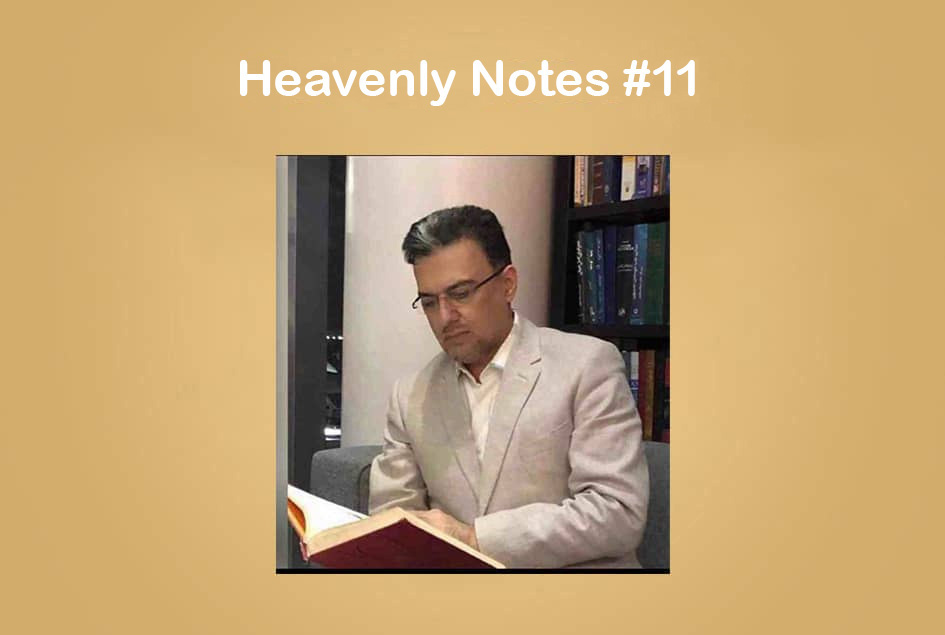
Third Discourse: Seyyed Mohammad Taqi Hashemian
Traditionalism in Iranian Culture and Art
Until a few years ago, when we spoke of tradition, it evoked in the mind a notion associated with backwardness and merely a return to the practices of earlier generations. However, the precise meaning of tradition from the perspective of traditionalists is such that although it is rooted in the past and looks toward the future, it lives in the present; it can be pointed to and defined through its characteristics. So much so that the relationship between spirituality and religious law (shari‘a) is compared to the relationship between the shell and the kernel of a walnut. Just as no walnut has meaning without its shell, spirituality too is meaningless without the shari‘a from the viewpoint of traditionalists. Shari‘a by nature contains practices whose repetition leads to continuity and permanence. These continuous practices and behaviors, which are deeply rooted in religious thought, are what we call tradition.
Iranian art, due to its religious orientation and its fusion with religious beliefs and doctrines, possesses a pleasant dependence on customs and traditions related to faith. The result of this relationship is traditionalism in culture and art, and more importantly, it is the secret of the longevity and flourishing of Iranian civilization. Its manifestations can abundantly be seen in architecture, calligraphy and manuscript production, illumination, painting (negārgari), gilding, tash‘ir, and decorative elements used in crafts such as carpet weaving, kilim, textiles, and even literature. These adorn numerous historical, artistic, and cultural collections inside and outside the country.
Because of this lasting influence and the important role tradition plays in the development and preservation of Iranian culture and art—and also due to the various approaches emerging in new artistic and cultural schools—many scholars in the fields of culture and art have turned their attention to it. As Dr. ‘Avāni says, if we lived two hundred years ago, discussion about tradition would not have been very justified, because we lived within tradition. But now we have separated from it and are in dire need of it. This very need has pushed us to present many different definitions of tradition.
Traditionalists define tradition as something based on divine revelation. The scope of this definition may differ among its proponents, yet the important point is that this universal concept—according to traditionalists—only acquires meaning when each person believes in it and practices it within the framework of their own specific tradition. Some of us see universality as the erasing of religious boundaries, but traditionalists do not. Although they believe in a transcendent unity and show utmost respect for the sanctity of each religion, they believe that spiritual elevation is achieved only when a person preserves the principles of the religion and tradition in which they were either born or in which they believe.
Traditionalism, when understood as being based on or committed to revelation, cannot be divided into two separate branches. If something is based on revelation, it must also be committed to it, and if it is committed to revelation, it is necessarily based on it. What traditionalists speak of, and refer to as the Perennial Philosophy or eternal wisdom, is a truth that is eternal—without beginning or end—and they form their theories accordingly. It can be said that adherence to revelation, or being based on revelation, is impossible without belief in revelation; consequently, a school of thought that claims to be based on revelation cannot exist without such belief.
The school of traditionalism, recognized as a method based on revelation, gains knowledge of the world through a perspective directly inspired by revelation. In the view of the traditionalist school in the field of art, the arts are divided into several categories, and religious art in the general sense of the term in Iranian culture is only one of these methods of expression. Other artistic approaches are based directly on the definition, understanding, and classification of revelation. Art in Islam originates from Qur’anic revelation, and thus in classification, it is called sacred art. In this context, perhaps calligraphy is the best example, and along with it, the recitation of the Qur’an with a melodious voice and Islamic architecture also belong to this group; for Qur’an recitation is a reflection of the divine word, calligraphy is the embodiment of the divine word, and architecture is a space in which God’s word resonates. Thus, from this point of view, method refers to how one looks at the arts produced by the traditionalist artist, and traditionalists do not separate method from style in this regard.
The art of divine revelation manifests both in the form of the artwork and in the impact it leaves on the viewer. This is especially evident in Iranian-Islamic arts. If we look at artworks such as painting, architecture, or manuscript production in the Islamic world before the Renaissance, we notice characteristics that involuntarily lift the human being beyond the earthly realm. Here we may refer to the art of negārgari (Persian miniature painting), which emerged in the Islamic world. As long as it maintained its connection to the source of revelation, it conveyed its beauty to the viewer. But when it became influenced by Mongolian, Indian, and Chinese arts, losing its symbols and introducing elements such as perspective and altered visual symbols, it no longer possessed its sacred character. It should be noted, however, that negārgari is not a sacred art; rather, it is inspired by divine unity (tawḥidī). It does not connect directly to the realm of revelation, but rather to the realm of imagination (khiyāl), from which it originates, and this differs from Western concepts of imagination. Yet, painting in the Islamic world—at least with few exceptions—has never been a purely secular art; its essence has been spirituality and unity, and in some works we even observe a halo of light signifying its spiritual nature.
