


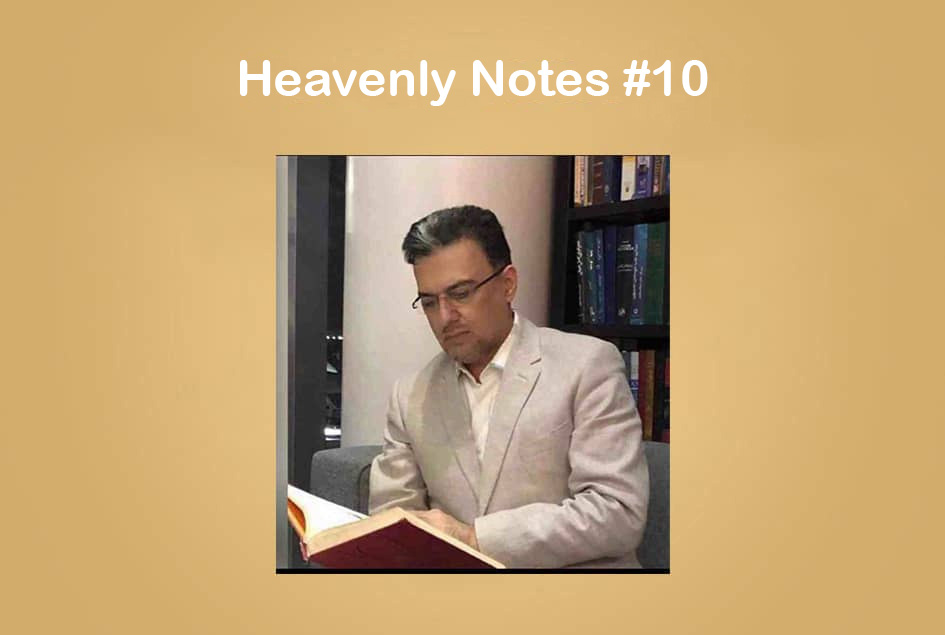
Continuation of the Second Speech: Seyed Mohammad Taqi Hashemian
Factors in the Flourishing and Permanence of Iranian Culture and Art
In the coloration of Iranian arts, Islamic mysticism flows vibrantly, and dark blue or indigo dominates over other colors. Blue symbolizes wisdom; it is a celestial color, a bridge between this world and the next, eternal and primordial. Blue is introspective, possessing a power that, at the height of its majesty, tends toward darkness, leading our souls with waves of faith toward the boundless distances of the spirit. For us, blue means faith, and for the Chinese, it is a symbol of immortality; it always refers to the realm of the heavens. (Seyed Ahmadi Zaviyeh, 1374 [1995], p. 261)
Other color combinations in Iranian art are also arranged in such a way that they provide overall harmony and balance, forming, with shamsa and eslimi motifs, a grand ensemble filled with spiritual and mystical themes.
Another group of arts whose designs have flourished in Iran, inspired by religious themes and Islamic beliefs, are works featuring garden patterns. These reflect the deep faith of Muslims in the afterlife and in Paradise, the ultimate ideal of believers.
The word paradise in the Qur’an is equivalent to Jannat or Firdaws, and phrases such as Jannāt ʿAdn or Jannat al-Firdaws are also used. The descriptions of Paradise appear in Surahs such as Al-Rahman (verses 45–78), Al-Waqi‘ah (verses 10–40), Al-Insan (verses 11–22), and Muhammad (verse 15). These are expressed metaphorically—with flowing rivers, verdant trees, flowers, plants, various fruits, birds, and heavenly maidens in a delightful, expansive garden. The space created in these garden patterns represents a sacred atmosphere reflecting the Garden of Paradise and its described elements.
In the designs—besides the general garden framework—streams and flowerbeds are symmetrically placed throughout. Usually, two main axes in the form of water channels divide the background, especially in carpets, into four sections, creating an overall pleasing harmony. The spread and flourishing of these garden-patterned artworks largely relate to the Safavid period (11th century AH / 17th century CE) and the Qajar era (12th–early 13th century AH / 18th–19th centuries CE), though they are still produced to some extent today. (Heshmati, 1374 [1995], p. 56)
Another type of ornamentation that became prevalent in Islamic Iran—and that embodies part of the splendor and endurance of Iranian-Islamic art—is the use of inscriptive decoration employing the art of calligraphy. Some inscriptions contain verses or chapters from the Holy Qur’an, engraved on the surface or borders of artworks—especially carpets and book covers. Others include complete prayers or excerpts from them, and some feature divine names (Asma’ al-Jalalah) or the names of holy figures and the Infallibles (peace be upon them). Interestingly, such works not only reflect the prevalent calligraphic style of their time but also highlight the religious beliefs and spiritual nuances of each historical period.
Respect for mosques and sacred shrines, as well as the culture of endowment (waqf), are two other significant cultural and social factors that have contributed to the continuity, elevation, and flourishing of Iranian culture and art during the Islamic era.
A. The status of mosques and the shrines of the Infallibles (peace be upon them) and great religious figures in the eyes of Iranian Muslims—and the reverence shown toward them—have played a major role in the preservation and development of Iranian art. This reverence has inspired artists to employ the utmost care, patience, and sincerity in creating works dedicated to such sacred places, hoping they would be accepted in the divine presence.
B. On the other hand, the waqf (endowment) culture has ensured the preservation and maintenance of works from various periods within mosques, sacred places, and artistic treasuries, allowing later generations to benefit from this vast Islamic heritage. Waqf—the dedication of property or an object to God for a specific charitable purpose, recommended and emphasized in Islam—has helped safeguard many Islamic artworks. The religious and devout have taken great care to protect endowed items, preventing their waste, sale, or transfer to unworthy hands. (Nojumi, 1379 [2000], p. 42)
C. A subtle but significant point concerning both waqf and respect for mosques and sacred places is the believers’ meticulous devotion in dedicating their finest and most exquisite artworks and creations to these holy sites or endowing them in the way of God. This reflects a deep love, sincerity, and servitude toward the Divine. Therefore, artistic works related to mosques—such as carpets, tilework, and others—are among the finest artistic achievements of faithful Iranian Muslims. This devotion itself has fostered the flourishing of these art forms. Numerous exquisite works from the Safavid period onward, found in mosques and sacred sites, have survived and now adorn museums both in Iran and abroad.
Given the discussion above—and considering that many similar examples exist or can be observed in Iranian art—the following points can be highlighted:
A. Symbolism in Islamic art has contributed to its continuity and flourishing.
B. The methods of worship, beliefs, and spiritual inclinations of Iranian Muslims have led to the creation, preservation, and flourishing of distinctive arts such as carpet-weaving, manuscript illumination, and architecture.
C. The culture of waqf and the preservation of endowed buildings and objects in Islam have ensured the survival of precious artworks, thereby enabling their influence on the artistic growth of later generations.
Based on these observations, the dominance of culture—as the central and connective intellectual element in the creativity of Iranians—especially during the Islamic era, has led to both the continuity and flourishing of the industrial and artistic crafts of Iran.
End of Part Two
